
Category Archives: Relationships

TCKs and The Twilight Zone

“Message in a Bottle” by Kraftwerck

Once in a while it’s important to reflect on how significant personal journeys start, particularly the one that initiaited with what means to be a TCK.  This blog was started was to be a resource for Third Culture Kids (TCKs) and the cross culture community.  This article, Where Everybody Is: TCKs  and The Twilight Zone, written for global magazine Culturs, published in April of 2015, is just that: a reflection on the TCK identity.


No matter what country I was living in while growing up, there was one television show that was constant and served as “comfort TV”:  Rod Serling’s The Twilight Zone and it so happens that the first episode touches on Third Culture Kid themes.

(***SPOILER ALERT for those who have not yet watched this episode!***)

Recently, I decided to search for the first episode to see how this classic TV show, which had me glued to the TV screen for each airing in any language at any age, started.  Of all the topics in the science-fiction-psychological thriller-fantasy-suspense, short-story-with-a-twist-at-the-end world, Rod Serling started this classic TV program, which first aired in 1959, with the theme of aloneness in Where Is Everybody?  

In this first episode, a man wanders into a completely deserted but fully functioning town he doesn’t recognize, with no memory of who he is, how he got there or why the town is empty.  The town is complete with running electricity, shops open for business, and cars as if they had just been parked.  In a diner, the man finds freshly prepared food and a burning cigar resting on an ashtray, but like everywhere else in town, nobody is around.  The man, dressed in an Air Force suit, roams through the town looking for anyone to talk to. However, he only ends up speaking to himself and gets as far as figuring out part of his identity when he sees a movie poster of a film based on the real life experience of Air Force pilot Col. Dean Hess.

At one point in the episode, the man says outloud, hoping for anyone to hear him, “You see, there’s some question about my identity.  Let me put it to you this way, I’m not sure who I am.”  Finally, he breaks down and starts despereately asking for help. At the end, the reality of who and where he is is revealed.

The plot twist in this The Twlight Zone episode involves references to isolation and the American entrepreneurial spirit in space travel.  A quick Google search about the days of the original airing dates of the The Twilight Zone  shows that they were aired every Friday at the time.  This episode, originally aired on October 2, 1959 may or may not have given a one-year anniversary homage to NASA, which “began operations on October 1, 1958” after being established through the National Aeronautics and Space Act signed by President Eisenhower on July 29, 1958.  There is more to be said about the political and historical context about the purposes behind American space travel at the time, especially during the Cold War, but to summarize a few, part of the purposes include: representation, opportunity and positioning.

The general reasons why Third Culture Kids (TCKs) grew up in different countries are due to a similar entrepreneurial spirit.  In most circumstances, global expansion can be seen as a socio-economic-political after-effect of historical Western expansion and imperialism, if considering the root reasons of how TCKs and the parents who raise TCKs came to international assignments in the first place.  The series of developments leading up to the economic structures and globalization trends we know today have roots in the economic intentions colonialists like Christopher Columbus and other settlers had in seeking new territory for expansion.  Although not all intentions for international assignments are imperialistic in nature, of course, the economic relationships between the global North and South and the context of international commerce cannot be divorced from the past of colonialism.

While there are various sectors within the global nomad community of individuals with families sent on international assignments by host nations as well as individuals with personal economic and other interests, representation, opportunity and/or positioning have been common purposes for international presence, most obviously for the military, corporate and diplomatic sectors.  There are similar, but more faith-based and/or philantrophic intentions for missionaries.  The decisions and options of those who become migrant workers who relocate for a job and others who do not fit the above categories are also influenced by the state of international commerce as we know it today.

Along with the benefits of a cross-cultural life, TCKs can also make personal sacrifices as a result of nations expanding their interests into new frontiers, similar to the man in Where Is Everybody?, who symbolizes the sacrifices NASA astronauts and other employees made as space travel became one of the nation’s priorities. (I left a few details out so you could possibly enjoy some element of surprise if you have not seen it yet.)  The children (TCKs) and spouses (Third Culture Adults) of those with a globally mobile career have our share of sacrifices as a result of being sent out to international postings.  TCKs and Third Culture Adults sacrifice stability of the living environment and staying close to family members, such as parents, siblings, other extended family members and, in some cases, children.  TCKs and Third Culture Adults also experience feeling different and isolated as a result of frequently being uprooted, which has the greatest impact during the developmental years, and experiences like feeling like an outsider in your own birth country.  (You may read more about the the experiences of Third Culture Kids in David Pollock and Ruth Van Reken’s Third Culture Kids: Growing Up Among Worlds.)

With the topics of identity loss, isolation and loneliness brought up in Where Is Everybody? and the parallels I saw between the character’s experiences in the episode and expereinces common to TCKs, I could not help but reflect back on the time when I felt so displaced about my own identity and felt so alone because of it.  Throughout the years before I discovered I was a TCK, especially when I was not surrounded by other kids who grew up internationally, I had to internally try to deal with feeling so different by myself in ways I could not even speak to others about because I lacked the language for it at the time.  I could not name my losses and much like this man who was tortured because he did not know who or where he was nor where everybody was, there was a large part of my identity and therefore ability to connect with others with my whole self that was suffocating and suffering.

Even Rod Serling has language for isolation being a serious “enemy”:  “Up there, up there in the vastness of space, in the void that is sky, up there is an enemy known as isolation. It sits there in the stars waiting, waiting with the patience of eons, forever waiting… in the Twilight Zone.”  Towards the end of the episode, one character states, “The barrier of loneliness — that’s the one thing we haven’t licked yet.”

Without a langauge for my experiences and without acknowledgement of who I genuinely was or what I’ve struggled through as a child, I felt invisible in front of everybody and therefore very alone and isolated, like the man in the Twilight Zone episode.  Without acknowledge of who you are and your personal journey that involved struggle, it can feel like being in a deserted town, speaking only to yourself, questioning your identity and maybe even mental state.  Some throughout the years have been able to only see the “me” that was familiar to them or that they could relate to.  However, they could not see my whole self and everything I fought hard to not be defeated by throughout chidlhood, even though I had no words for it at the time and had no idea how many other people felt the same way I did.

The threat of isolation only points to the very basic need for human connection, which validates why TCKs feel the sense of urgency to just be seen, understood and connect.  This is also why today, I am so very grateful for coming across the cross-culture community of global nomads and TCKs.  Thank you to you all who have spoken up and created space for us to connect.  The moment I discovered you all, I was able to start feeling like I knew where everybody was at.
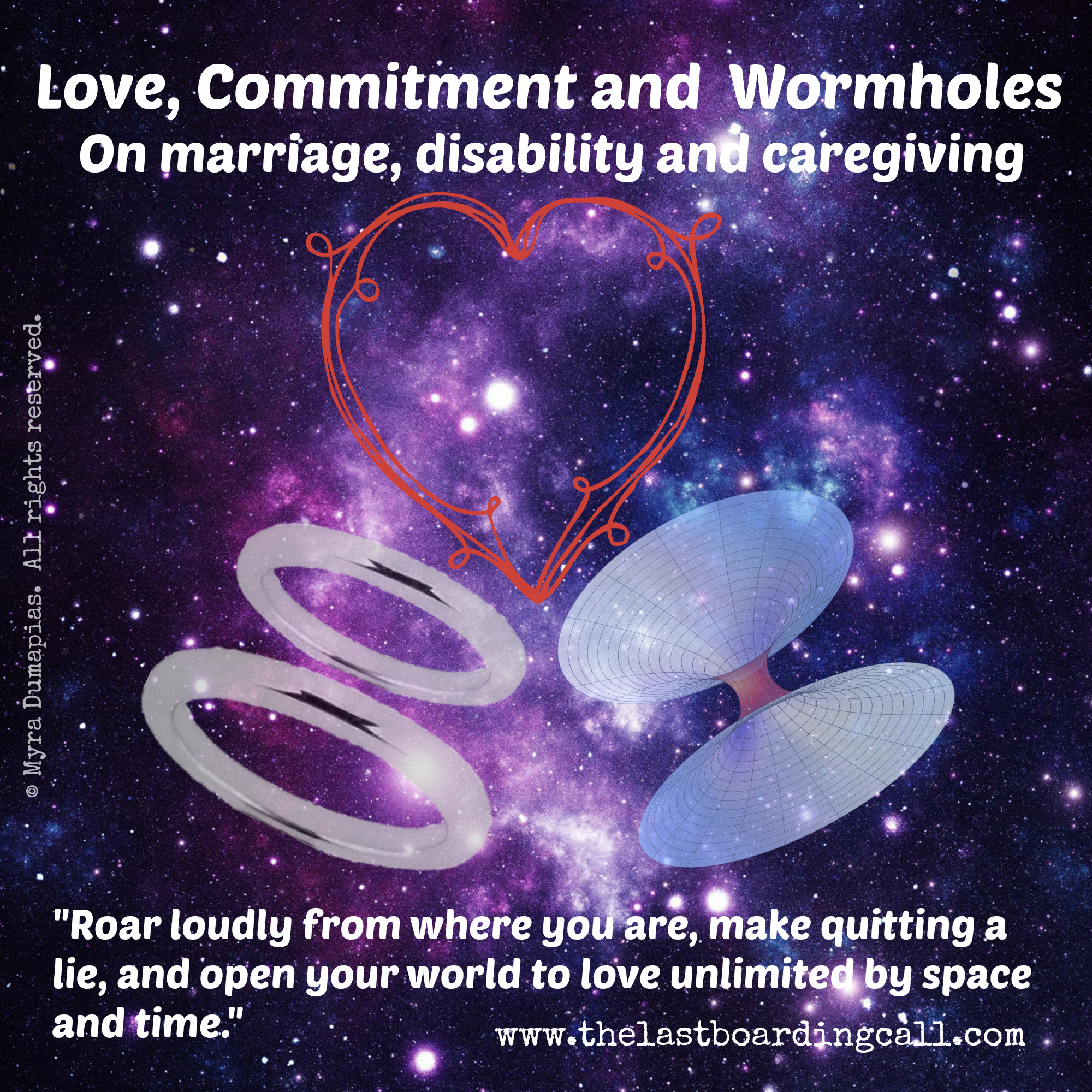
Love, Commitment and Wormholes: Three Observations about Marriage, Disability and Caregiving

LoveCommitmentWormholes_Lrg2

The best marriage training anyone could ever receive is through helping a married couple when one has a disabling condition requiring caregiving.  In the system of services for family caregiving, aging and sudden disability, there is little focus on the pre-existing quality of the marital or committed relationship between the caregiving spouse and the dependent spouse with an illness or disability.  In comparison to the financial, medical, and other health needs of someone with an adult onset disability or chronic illness, details of that person’s marital relationship can seem trivial.  Yet it plays a major role in the quality of life of the persons involved.  I had the honor of closely observing my parents’ marriage, which survived the challenges that come with caregiving and disability, and how they maintained quality in their marriage.

Various and complex factors can impact a marriage, but a disabling condition of one person can change everything. Available statistics on the rate of divorce or marital breakdown for marriages that have one person with a brain injury-related disability, for example, range from 15% to 25% (and 78% if including a study with a small participant size).   A study of anecdotal information revealed a common theme involving a drop in income and an eventual “burn-out over having to take care of the disabled spouse and seeing their quality of life eroding.” This in turn leads to “the abled spouse initiat(ing) a divorce, even though ‘feeling guilty’ about doing so.”


…You can be frustrated at how the other person is handling the situation, but at the end of the day, which is it that you really want to quit, the person or the situation?


For a real life first person example, one can read a sobering forum post initiated by a spousal caregiver seeking support about the sense of loss of the marriage he once knew with his wife before her stroke, while adjusting to the demanding role of a caregiver.

In our situation, my mother had a stroke in 2002 that left her requiring full-time caregiving. She was unable to sit up, walk or go to the bathroom on her own, and, in the beginning, unable to interact or speak with us with full consciousness.  She temporarily had a tracheostomy for a ventilator, because she was in in a deep coma for almost three weeks.  The brian injury from the stroke led to my mother needing a feeding tube in her stomach as the only way she could be fed for the rest of her life.  Although not fully conscious initially, it became clear in time that her speech, although with a raspier voice, as well as her memory and her personality remained intact, with some moments of less emotional self-restraint.  

Providing care for my mother was demanding and the drastic changes for her required tremendous strength to live through without depression, especially through six cities in four countries. However, the extra, almost 12, years with my mother is so very precious to us all.  She watched her only grandson grow up into a teenager. We bonded more as mother and daughter. This was special because I spent some years of my childhood away from my parents due to economic realities of foreign service careers based in countries economically poorer than Western countries.  My mother got to age with her dear husband and partner through a lifetime of international transitions and postings.  Some of these posting were very challenging, but not as challenging as how they spent their last 12 years together, seven of which my father was her primary caregiver, which especially impacted my parents’ quality of life and marriage.

According to a study by Perry Singleton, “couples with lower quality marriages are more likely to divorce than couples with higher quality marriages.”  I was blessed to be able to witness my parents’ marriage, seasoned with many victories the surmounted typical marital problems as well the challenges that come with frequent upheavals and transitory nature of a globally nomadic life, survive their final stage of caregiving and disability.

Below are three of the many observations I have made about my parents’ relationship in the final stages of their marriage:

1)   My parents did not hold back in being and expressing themselves.


Roar loudly when you are going through something significant!  Even self-acknowledgement of how you are affected can go a long way.


My mother, with her strong personality that most people who know her note about her, didn’t hold back when it came to expressing her needs around my dad.  My father on the other hand, who is more reserved and quiet, wasn’t often expressive about his needs.  However, he was himself, so when he was silent and when he did speak up, my mother knew what each meant.  Their old patterns of communication as a married couple carried over to their life roles as a caregiver and disabled spouse.

By not holding back what they felt or needed, my parents rode each wave of tension for as far as they could handle as individuals and as a couple, but they got on the waves and didn’t swim away from them.  Yes, not many people would sign up to get on the waves, but they did.  As they did, my parents roared loud expressions of how they were being affected, in the form of speaking as well as silence, to stay on those waves.

My parents made a decision decades ago, believing a person’s word at the wedding altar meant something beyond the first several years of marriage. They stuck to that decision until the end, and as they approached their last stages of their life together they did so LOUDLY.   Roar loudly when you are going through something significant!  Even self-acknowledgement of how you are affected can go a long way.

2) My parents lied about quitting each other.


 …Plan to turn every statement you have made or may ever make about quitting a good relationship or marriage into a big fat lie and make sure the other person knows you will always be lying about that.


Did my parents at least at one point each express they wanted to quit either by death or physically leaving?  Yes. Afterall, they didn’t hold back from expressing themselves.  But at times expressing oneself is just that.  Not everything you express outloud is necessarily a threat that has to be carried out.  Sometimes expressions are to share frustrations rather than actual plans of action.

What can be confused in the expression of frustrations is what each person is frustrated at.  Is each person frustrated at the situation or truly the other person?  Yes, of course you can be frustrated at how the other person is handling the situation, but at the end of the day, which is it that you really want to quit: the person or the situation?

Each time my parents surpassed a conflict, after each wave of tension died down and they roared loudly from where each were at, there was always a new dawn that rekindled their love for one another and there were actually many many more days of laughter and affection than the tension filled days.  My parents commitment to one another was more than just a legal decision to permanently stick to something you signed for on a binding contract.

Each wave my parents’ surpassed was an elevation to a new level of love for one another.  Theirs was the type that seemed to see in each other at least the core value of life of the one they had been the most intimate and vulnerable with, in all the ways two human beings can ever be, with only free will propelling this love forward.

At times, this could be the only reason left when fond memories aren’t enough to make you feel the emotions to keep going, especially after looks fade and the life you once shared is a thing of the past.  Perhaps not everyone, whether single or married, may experience this love.  However, one way to possibly to do so is to plan to turn every statement you have made or may ever make about quitting a good relationship or marriage into a big fat lie and make sure the other person knows you will always be lying about that.

3) My parents’ love knew no boundaries of space and time.


Facing the toughest challenges in a marital or commited relationship may be the key to opening your world up to wormholes, or unimagineable depths of love unlimited by space and time.


The most romantic moments I have ever seen between two people in my life were enacted each time I watched my father patiently feed and clean up after my mother, who would reach over to express gratitude through a wordless but overwhelmingly affectionate soft caress of his arm while they looked into each others’ eyes.

These were the moments that demonstrated to me why couples ride waves of tension together, loud as the ride may be, then ride another one, and another one until there are no more.  They way my parents looked into each others’ eyes during moments like this was the same way they used to look at each other in younger years when both were able bodied and able to travel, eat and move about freely.  Their love for each other was timeless.

There is one date I remember my parents used to reminisce about before my mother’s stroke.  What was cute was the way they would each separately talk about a certain date they had for one of their anniversaries in Seoul, S. Korea.  They each, separately, would fondly talk about the same details of that evening: the ceiling painted with clouds, the beautiful and blonde haired harpist playing in the corner and the overall pleasant ambience of the restuarant, all working together as the backdrop of the wonderful time they had with each other that evening – an evening they would both jokingly describe as, “like being in heaven.”  Almost 30 years later, my parents still reminisced about this evening with the same fondness for this moment they shared in time.  

Today, my father recounts the same evening with the same fondness and sentimental value, smiling and laughing at the same details that have only partially illustrated what seems to be a whole universe of an eternal evening full of very special moments for both.

It is as if there is a wormhole my parents frequently travelled through because the quality of excitement in my parents eyes, voice and smile they would reminisce with about that one fancy and special anniversary date was always fresh. It was as if that date always just happened the evening before, even after almost 30 years later in a completely different country, right from the comforts of a bedroom set up for an elderly person with a disability.  

My father says, “you don’t know how deeply you can love someone until you serve them.”  Perhaps it is this level of love that helps to makes special moments like this anniversary date eternal.  Perhaps it is no coincidence that a married couple tested through the challenges of caregiving and disability, can keep special moments like this fresh and alive.  Facing the toughest challenges in a marital or commited relationship may be the key to opening up your world up to wormholes, or unimagineable depths of love unlimited by space and time.

In the realm of love, there is space for life that never ends if you don’t let it die with drastic changes in a your beloved’s physical condition or last breath.  In the realm of love, space and time do not serve as limitations but as mere background details for eternal moments.  In the realm of love, being real includes forever.


About the Author

© Myra Dumapias and The Last Boarding Call. Unauthorized use and/or duplication of this material without express and written permission from this blog’s author is strictly prohibited. Excerpts and links may be used, provided that full and clear credit is given to Myra Dumapias and The Last Boarding Call with appropriate and specific direction to the original content.

In Sickness and In Health

MarriageVows2

Marriage vows from my parents’ wedding album.

In Sickness and in Health: The First Year of Grief, in My Father’s Words

My father has five pieces of advice from his first year of grieving since my mother passed away, but first let me describe their marriage.  If you have ever found someone you could be your complete self around without having to hide a part of who you are… someone you could be the angriest self you’ve ever been but find them still around long enough that you share your next laughs together… someone who knows you so well that when they look into your eyes, they are already listening to you…  someone who has learned what words can break you and breaks each time they regret ever saying them in the past, you’ve been blessed with something not everyone has.  I’ve witnessed this type of love in my parents’ marriage.

Throughout my parents’ marriage, they loved each other through the various emotions human beings can ever feel and through the different stages intimate relationships usually go through.  I witnessed the strength of their love through different seasons like a tree that sways with changes, but still remains standing tall and alive after the storm passes.   I cannot imagine how my father feels without his long time life partner now for almost a year, the longest they have ever been apart since they got married.  Therefore, I decided to let him share his own words about the past year:

MYRA:  Papa, it is almost a year now, coming up in about two weeks that Mama left us. Do you feel different in your journey of grieving Mama at this time compared to how you felt last year? 

PAPA:  Even until now, about a year after, I still feel part of me is empty.  In fact, my grief for her departure is as deep as the hour she left.  Perhaps to console myself, I sometimes stand next to her bed and blurt out that I miss her, and I love her.

MYRA:  I do something similar when I miss her, but I can’t imagine how you must feel.  Not long after Mama passed away, I remember speaking to a neighbor who described her feelings after her husband died as having a hole in her heart.  She also lost her mother around the time she lost her husband.  She said that losing a spouse is a different, more intense kind of pain.  

Does this describe how you’ve felt?  Can you describe how that pain has been and the process you feel you have gone through in the past year? 


…There is something very personal that touches the innermost sensitivities of our soul when we lose someone with whom we’ve shared our most intimate feelings and thoughts throughout the years.


PAPA:  Losing anyone you love is painful as it is, whether it is your parents or a brother or sister.  But there is something very personal that touches the innermost sensitivities of our soul when we lose someone with whom we’ve shared our most intimate feelings and thoughts throughout the years.  Eva had been by my side as a young mother of our only daughter – you, Myra – through the challenges as well as  joyful times from the martial law years in the Philippines, to the postings in China, Malaysia, Germany, Romania, South Korea, Bahrain, and Mexico.  We were together when we experienced the saving grace of the Almighty in the revolution period in Romania, when we shared the Gospel to the Filipino workers in Korea and Bahrain, and when we experienced God’s miracles in the Kingdom of Bahrain.  

To an elderly man or woman who suddenly lost a partner, any moment of the past is very special and can trigger nostalgia as well as pain at the sudden realization that someone we used to share stories and laugh with daily is no longer around.  So we sit back in silence.   


A spouse does not find the depth of their love until they serve their partner.


Even months after she joined the Lord, I still could hear her voice calling “Papa!”  In her last seven years, she was bed-ridden as a stroke survivor, and I was her primary caregiver twenty-four/seven.  In Eva’s last fourteen months, you, Myra, sacrificed much of your time providing extra care for her.  For several months after Eva’s memorial service, whenever I went anywhere, I still felt I should rush back home “because Eva is waiting for me,” I always said to myself.  

Although those last years demanded many sacrifices – short hours of sleep, irregular meals, etc. – to me, they were worth much more than otherwise.  I will never exchange all the moments we spent together even as she was in a wheelchair and later bed-ridden.  A spouse does not find the depth of their love until they serve their partner.  The more a spouse sacrifices for their husband or wife, the deeper becomes the love.  No wonder Jesus washed the feet of His disciples and said to them, “If I don’t do this to you, you have no part of me.”      

MYRA:  What has been the most helpful for you since Mama passed away?  What activities, conversations, words, etc. have helped?


Continuing closeness with family….”extended family”….the “outside world”…


PAPA:  Having my daughter and grandson to share those moments of sadness with, as well as the presence of Eva’s siblings who visited, and the prayers and kind words from friends, neighbors, relatives and the church gave me much comfort.   Beyond the period of mourning, the continuing closeness with family – you and my grandson – significantly eases the pain.  The ever-ready kindness and attachment assured by my brothers, sisters, cousins, uncles and aunties as well as friends from our younger days are irreplaceable.  The consistent understanding, patience, and help from friends and neighbors give me assurance that as I readjust to a new life, I will not be alone in the journey.  In practical terms, they are part of my “extended family” in San Antonio.  Fellowship with members of the churches we attend had also helped in my transition to the “outside world.”  

Working on the book that the Lord had impressed in my heart to finish re-directs my soul from grief to a meaningful existence, now that my partner in life is gone.  Joining a writers’ group recently has given me encouragement and technical assistance especially in the areas of editing, interior/book cover design, and marketing in a self-publish but affordable approach.  In a sense, the writers’ group is my first social activity since my wife died.      

But most important of all is the Lord Jesus Christ who gives me strength in every step of my journey from the depth of sorrow.  

MYRA:  Are there any encounters or situations you have had that was not very helpful in the grieving process or you think would not be helpful to anyone who recently lost their spouse?  


…Every neighborhood association should have some type of protocol for bereavement so that there are less burdens for the family.


PAPA:  When something tragic happens in our life, there are things that we neglect to do.  For several months, from winter until Eva departed in March, I had not cut the lawn and the grass had grown tall.  Someone complained and talked to the other neighbors that I “should take care of my property.”  Although he was right, I wish he was understanding enough to give me time until I could regain from the shock of loss.   

MYRA: Yes I think that was about a week after she passed away and the aunts and uncle had just left.  We were all still in shock because everything happened so fast.  I had to explain to his wife what happened.  I think every neighborhood association should have some type of protocol for bereavement so that there are less burdens for the family. In fact, that’s what the neighbor who is a widow mentioned to me, that the neighborhood association we have used to have bereavement acknowledgements in the past.

Papa, thank you for spending time to share what is on  your heart about the first year since Mama’s death.  In closing, do you have any advice to offer people out there in the aging journey, people who may have just lost their spouse, or people who are concerned about widows/widowers they know? 

PAPA:  Yes. I have five things to share:

1) Eva was prepared when her time came.  She had accepted the Lord years before, and she had set her mind to accept the inevitable.  She already talked to the chaplain, shook her head when the nurse’s aid said “I’ll see you next week,” and in her last three days she was singing a good-bye song and was shouting “Papa, I love you.”  Her husband, only daughter, and only grandson were with her, at her home, in the final hour. Those who are about to leave us are believed to know when it is their time.  They are at peace with their destiny if their faith assures them well in advance of their place in the Kingdom of Heaven, that they are loved especially by their family, and that the loved ones they will leave behind will be in good situation.  

When a surviving spouse knows that the departed partner was prepared and is assured that the partner is in a better place, ie. in God’s paradise, the widow/widower can find it easier to process the shock. 

2) I have never felt closer to Eva as when I was taking care of her, day and night.  It was special quality time. The “sacrifices and inconveniences” are actually opportunities to show how much you love your partner and how much you appreciate their presence in your life.  

So be glad when you can do something for your spouse, whether he/she is well or ill.  

3) Whether you are young or old, you should take advantage of the time you have with each other to say – expressly verbalize – “I love you.”  You never know how long you will have such luxury of being alive.  Make the habit of saying the words from the moment you wake up. Even if your partner is abroad or at work, call up as if it is the last chance you have.  And serve them with the dedication as you did with your partner when he/she was still active and healthy; you will feel more deeply in love with them.    

To all the people you love, especially your spouse, children, grandchildren, and siblings, say to them how you feel while you can do it.  

4)  I remember a friend who delayed his trip when his mother was seriously ill.  By the time he visited, his mother had already died.  He regretted it so deeply that until now, he still keeps the watch he bought as “pasalubong” for his mother.  

The most painful of all is regret… thinking, “I should have done it” when it is too late, when the other person can no longer see or hear you.  

So don’t procrastinate.

5)  After the departure of your partner, strike a balance between your grief and your sanity. Have a project that will keep you interested and mentally alert as well as physically active.  For me, finishing the book has kept me going spiritually.  If I can find employment regardless of the position and salary, as long as it helps pay the bills and keeps me active, so much the better.

You must make an effort to stay active and involved in the things you care about.


When Christmas Is Not Merry

Background Image, “Christmas Bokeh” by Freddie Brown, used with Creative Commons license


This holiday season is not necessarily a time full of joy and giving for everyone.  Some may be grieving and need to have the time, space and support to do so.


None of us have put up a single Christmas decoration or played a single Christmas tune in the house and this is perfectly okay.


Some are grieving a loved one they have lost or, due to their stage in life, multiple losses of peers contemporary to their age as well as family members.   Some may be experiencing a bittersweet last Christmas with someone who may not have long to live.  Some may be trying their best to move through the holidays with a condition that incapacitates all efforts to celebrate the way they used to.  Some are not able to give of their time, presence or resources because of financial struggle.  For the global nomad or expat community, financial difficulty can mean being far away and isolated from dearly loved family members or friends.

For my readers who are experiencing any of the above or similar situations, please know that you are not alone.  This is my family’s first Christmas without my mother.  None of us have put up a single Christmas decoration or played a single Christmas tune in the house and this is perfectly okay.  This is just how it happened.  I did not plan it, but it was my mom who looked forward to putting the Christmas decorations up and playing the Christmas songs.

Growing up as a Third Culture Kid (TCK), there were times when Christmas did not look like a greeting card or the happy endings in Christmas movies.  There were years I lived separately from my parents and sometimes only one parent could visit for Christmas until I was old enough to travel by myself for an international holiday visit.


 I had seen news images of the revolution and damages in the city, not knowing my parents lived in a crossfire, before I knew exactly where they were and before I could even say “Merry Christmas” to them over the telephone…


The first year I was not together with both my parents for Christmas was my first year as a college student.  I was in California and my parents, who were assigned to Bucharest at the time, were travelling between Eastern European countries to get out of harms way during the Romanian Revolution of 1989.  They experienced difficulties from a car breaking down after hitting a large deer, to not knowing if they were about to be ambushed, to driving without visibility.

They later returned to their residence with the front outside wall of the house riddled with bullet holes and bullet shells scattered across the driveway.   I had seen news images of the revolution and damages in the city, not knowing my parents lived in a crossfire, before I knew exactly where they were and before I could even say “Merry Christmas” to them over the telephone (remember, there were no mobile phones, GPS, commercial use of the internet or data plans at the time).

Christmas has not always been picture perfect, but nothing prepared me for what I am experiencing as well as what the rest of the family is experiencing. Days are tolerable.  I have many funny memories of my mom’s cute and funny statements and ways, but there is a void that will never be replaced.  It is a void that I, on a daily basis, intentionally do not let myself drown in because it would engulf me.  

So it is okay if I do not display the Christmas decorations that remind me of where my mom wanted them placed last year.


Even the simple act of acknowledging someone’s loss and recognizing the value of the loss helps greatly.


My father has been staying afloat with his faith as his primary vessel, even through the moments he keeps to himself, but, I can tell, are less tolerable.  A neighbor who lost her husband several years ago once described the loss of a spouse, different from the loss of a parent, as feeling like a literal “hole in (her) heart.”   For my dad, this holiday season involves memories like exchanging simple Christmas gifts and greetings in a car stranded in a blizzard somewhere in Eastern Europe, when the most valuable gift is each other’s life.  

So it is okay if my dad does not switch the radio to tune into Christmas songs the way he used to every year while my mom was no longer able-bodied.

My son also keeps his emotions to himself, but I know he also feels the void and misses his confidante.  I am witnessing how he, as a teen, does what he can to be as supportive as possible of his grandfather and mother through this season.  His growth into adult years involves the lasting impression if my mother, whom he came to know not only throughout his childhood, but now through the stories we tell about her.  

So it is remarkable that my teen son even thought of using his hard earned money from his part time job to buy Christmas gifts for us.

For my readers who know families who may be experiencing a loss of some sort at this time, I hope you can offer some support.  Even the the simple act of acknowledging someone’s loss and recognizing the value of the loss helps greatly.


 The pace and expression of grief is different for everyone, especially during the holidays.


There is no benefit to expecting or pressuring anyone to demonstrate emotional or spiritual strength by acting joyful at this time.  There is a difference between letting someone know they are not alone and offering support in the form of company or sharing a meal, and expecting changes as a result of your support.  The pace and expression of grief is different for everyone, especially during the holidays.

A member of a family that was at least at one point globally mobile can be experiencing more than one of the grief situations I mentioned above.  Thus, it is important that we, a community of globe or cross-cultural trotters who most likely have said more goodbyes than we wanted to, honor those who are grieving and the way they wish to grieve this holiday season.

This season may not be picture perfect or resemble happy endings in Christmas movies, but it can be a time to reflect back and honor the perfect and happy memories of loved ones.

I leave you with this holiday greeting I posted in social media on December 24, 2013:

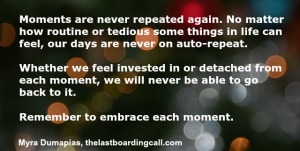
Moments are never repeated again. No matter how routine or tedious some things in life can feel, our days are never on auto-repeat. 

Whether we feel invested in or detached from each moment, we will never be able to go back to it.

Taking a mental snapshot of this time when I can embrace both my parents, my son and our dogs.

Sometimes it takes a painful looking back at the past to realize things were never the same again.

May we all have more of the gift of consciousness of what we’d miss, looking back, in each “now” moment…my hope and prayer for all of you out there this holiday/ Christmas season.


Thank you all for reading and following my blog posts.

Until our next hello in 2015,

Myra Dumapias

Background Image, "Christmas Bokeh" by Freddie Brown, used with Creative Commons license

Background Image, “Christmas Bokeh” by Freddie Brown, used with Creative Commons license

Confronting Goodbyes

“Goodbye” by Gybsteria, used with Creative Commons license

[Once in a while, there are some topics that have particular meaning to caregivers or the aging population, but also hold significant meaning to global nomads or Third Culture Kids of different ages.  How we say goodbye is one of these topics.  This article, “Confronting Goodbyes,” was originally published in Culturs, a “global, multi-cultural lifestyle magazine for Global Nomads, Third Culture Kids and racially-, ethnically-, and culturally-blended people.”]

If I had a shirt I could have worn throughout my childhood and teen years of moving around the world, it would spell out these words from my all-time favorite quote: “I hate good-byes.”

Good-byes for me meant leaving countless close friends I could be completely be myself around. I had to constantly leave behind or be left behind by the friends I had sleep-overs with, tape recorded little adventures with, and shared secrets with.  A history of “last times” with friends I grew up with, in one to two-year time spans, perforated the timeline of my days with them.

Good-byes also meant living away from my parents through some childhood years that will never be repeated.  When the tuition of the limited options for English education was beyond my parents’ budget, I at times needed to live with my grandparents and cousins in another country. Political unrest in the country of our expat assignment also sometimes led to the need for me to live away from my parents.


 Frequent goodbyes can make one want to feel numb.  However, I am not. Something always pulled me back to feeling the pain of good-byes each time they happen and I could not figure out why I had not developed a coping mechanism to feel less of the pain as I got older.


I also had to let go of favorite places, classes, teachers and school staff, foods, and TV shows.   Good-byes cut short the time I had with loved ones as well as whole environments. This can take a toll on emotions when it’s repeated so frequently and when it occurs before a child or adolescent has had a chance to know what stability feels like.

Frequent goodbyes can make one want to feel numb.  However, I am not. Something always pulled me back to feeling the pain of good-byes each time they happened and I could not figure out why I had not developed a coping mechanism to feel less of the pain as I got older.  I took psychology courses in college and learned more about human development in my graduate education for social work.

None of the theories or case study exercises ever seemed to satisfactorily address my sense of grief at goodbyes, the enormity of its effect in my life or the way newer goodbyes, even those I that were unintentionally re-enacted by children around me, were connected to the goodbyes of my youth.

I only figured it out when I experienced the deepest goodbye I have ever experienced in my life thus far: the goodbye journey I had with my mother when she passed away.  It was not until she passed away earlier this year that I reflected on how she said goodbye to me throughout the years.


 …she would watch her loved one not only board a plane, but watch the plane fly away until it was smaller than a dot in the sky.  My mother would watch the car of her loved one drive away until it turned a corner or the tail lights were so far they were less than sparkles at night.


My mother would confront each goodbye with me and other loved ones through the very last minute moment of it.  Before the historical event that changed airport security practices worldwide, she would watch her loved one not only board a plane, but watch the plane fly away until it was smaller than a dot in the sky.  My mother would watch the car of her loved one drive away until it turned a corner or the tail lights were so far they were less than sparkles at night.  She would watch my school bus drive away until she could no longer see it after shifting her position or peering around obstacles in her line of sight.

My mother knew how to say goodbye because she did not fear the pain of it.  She confronted the pain of goodbyes in a way that most think unnecessary or too overwhelming to tolerate.  It seems almost unthinkable how a wife of a foreign service career diplomat who moved so frequently can still be willing to feel the pain of goodbyes.  After making a home for her family and connecting to friends as intimately as she would with her own siblings or children, she would time and again leave behind everything she whole heartedly put herself into.

I wondered, “How did she do that?  How can my mom bear the pain over and over again?  How can it not tear her down to wanting to just give a little less the next time around and even less after that?”

When I think about my parents’ last foreign assignment, in Bahrain, I am even more bewildered.  It was at this last post that my mothers’ capacity to connect to people seemed to shine the brightest.  Her own brother mentioned how shocked he was at the countless number of my mother’s genuine friends during his visit to Bahrain.  In the single setting of a hospital waiting room, my uncle witnessed a diverse pool of visiting friends who were deeply affected when my mother had a major disabling stroke at the age of 57.  The repeated visits of numerous friends arriving in shifts for weeks demonstrated to him a deeper level of friendship than courtesy visits for a diplomat’s wife.

Reflecting back, this meant that instead of giving less of herself after each goodbye, she was able to become even more genuine after each move.


…the reason why my mother was able to connect so well to people was her lack of fear of the pain of goodbyes.  The reason why she faced the pain of goodbyes was so that she could look forward to the next hello again and again…. It was as if she knew she would not run out of what sourced her to keep giving.


I grew up noticing how my mother would start a conversation with a stranger and show genuine interest in the stranger’s children and spouse, sibling or aging parents they left behind.  She connected with people of different backgrounds: from the visiting Korean concert pianist who accompanied a world touring Filipino violinist, to the Filipino factory worker, to the photographer for the royal family, to the husband and wife musician team at the hotel, to fellow ambassador wives who also missed their children who were away .  In turn, they connected with her as their mother, dear sister, or aunt.  In person, I have met at least five individuals who called my mother, “mom.”  I am an only child.

It occurred to me that the reason why my mother was able to connect so well to people was her lack of fear of the pain of goodbyes.  The reason why she faced the pain of goodbyes was so that she could look forward to the next hello again and again.  Feeling the pain ensured she was still present and that she had herself to offer again for the next hello with her loved ones as well the next hello with strangers. It was as if she knew she would not run out of what sourced her to keep giving.

My mother grew up in the era when overseas travel involved loved ones parting at a ship dock.  The person on the ship would throw and stay connected with the person at the dock with a string one person would hold on one end and the other person would hold on the other until the string snaps. I believe my mother faced the heart-wrenching emptiness of watching someone leave and withstood the position of being the one left behind because emotionally, she knew she would be ok after feeling the pain.  Finding a way to live with the pain of goodbyes allowed her to spend every last moment possible in the presence of those she loved.  Even to be near enough to the plane that took off was special to her. The cost of the pain in doing things like this was worth it for her.  Perhaps this fueled her until she could make it to the next reunion with loved ones.


 It is healthy to feel pain.  We need to embrace the heart-wrenching pain of goodbyes so that we can embrace the joys of the hellos and the connections that can form from them.


We as a Third Culture Kid or global nomad tribe must know that we can be ok after feeling the pain of goodbyes so that we can look forward to the next hellos.  It is healthy to feel pain.  We need to embrace the heart-wrenching pain of goodbyes so that we can embrace the joys of the hellos and the connections that can form from them.

I realized the answer I was looking for just were not in textbooks.  I hated goodbyes and hate the remnants of painful goodbyes from my youth still, but I continue to face them anyway because it is part of the journey of valuing relationships.  Without feeling pain at the last moments with people we value, how do we know we are allowing ourselves to experience the full extent of vulnerability that allows for growth in relationships?  Pain is a miserable emotion, but without it, we miss out on the broad spectrum of life and relational experiences.  Without pain, how do we know we are truly alive?

The entirety of my all-time favorite quote states,

“Why can’t we get all the people together in the world that we really like and then just stay together forever?  Someone would leave. Someone always leaves. And then we have to say good-bye. I hate good-byes… You know what I need? I need more hellos.” (Charles M. Schulz, “Snoopy, Come Home!” 1972, song “It Changes”).

The next time you find yourself dreading goodbyes, consider how your last goodbyes can prepare you to embrace your next hellos.


Dedicated to my mom, Evangeline V. Dumapias, who passed away on March 15, 2014 and all wives or husbands who give so much of themselves in their support of a spouse with a globally mobile career.

About the Author

Expat Youth In Aging and Disability: Why It’s Not Just about the Elderly

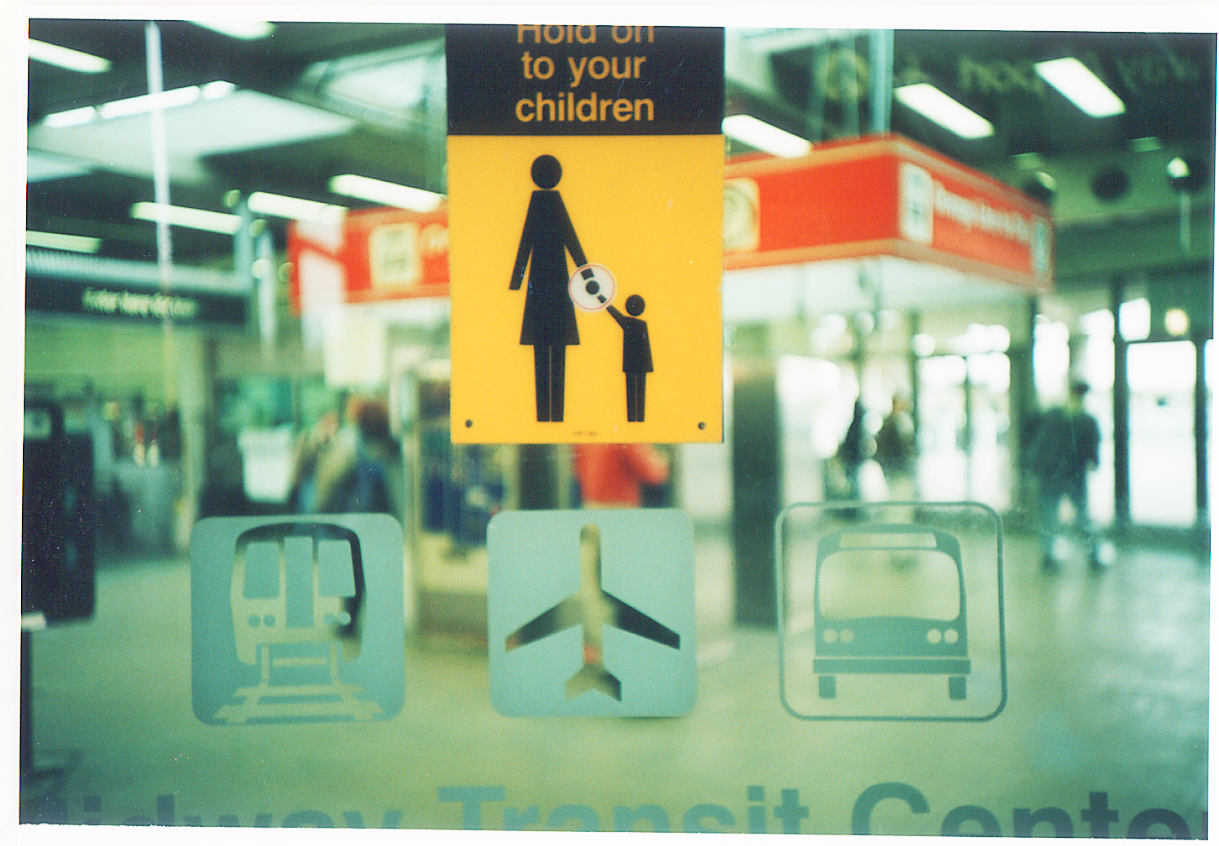
"Hold On To Your Children" Photo Credit - Spiesteleviv Used with Creative Commons license

“Hold On To Your Children” Photo Credit – Spiesteleviv Used with Creative Commons license

We see families at the airports, at times perhaps with more than two generations represented, briskly walking through the terminals in long single file or as a wide marching band at a parade with various carry-on luggage as musical instruments.

While middle aged adults that pass through the airport corridors seem to begin to resemble one another in attire, the younger passengers tend to show more individuality:

…the teen girl with a partly shaved head with purple tips wearing a Ramones t-shirt, the tween boy with one eye covered by his long hair dressed in black or grey clothes, the cosmopolitan little lady wearing her kid sized tweed travel jacket with suede elbow patches, the toddler with a bowl haircut in the stroller calmly snacking on soft cookies while the mom is dashing for the connecting flight, and the baby in the infant carrier kicking the air and giggling at strangers behind his father who enlarge their eyes as part of their big open-mouthed, head nodding smile.

If we could see a floating bubble attached to each family member narrating a summary of each person’s story or reason for the trip, we’d probably be amazed by the depth of what we don’t know about strangers.  Out of these stories are trips adults make to tend to a family member experiencing a sudden health crisis, and their children, whether they travel with their parent(s), stay behind or end up following after, are affected.

Photo Credits: Yogendra Joshi Used with Creative Commons license

“Granny… I Am Coming!” Photo Credits: Yogendra Joshi, used with Creative Commons license

My son and I lived one of these stories.  I received the call that my mother had a stroke the night after my son attended his first day at kindergarten.  We were in Los Angeles, California.  My parents were in Manama, Bahrain.  I was preparing to start my second year for my Masters in Social Welfare at UCLA.  I had just met my supervisors for my second year internship placement.  I was about to serve as one of two co-presidents who tied in elections for the Social Welfare Asian Caucus that upcoming year.  That would have been my final year for a graduate program that accepted only 20% of its applicants.  My son had to take leave of absence after just one day in kindergarten and I had to file for leave of absence before my second year orientation even started.

Since that phone call, our lives as a collective family as well as each of our lives individually, were never to be the same or “normal” again.

I had no idea that the photos I took of my son’s first day of kindergarten were not going to be the first in a series of photos representing the traditional path of education most children living in one country take.  I had no idea it would take me several years to finish my masters degree for a program that usually lasts for two years.

When my son and I left to go to Manama, I only knew a portion of what I was about to find out as soon as I landed.  It turned out that what I thought was a mild stroke for a 57-year-old woman was actually a severe stroke, involving the cerebellum and a coma. My mother’s doctors did not hold back from preparing my dad for funeral arrangements.

It was a long journey itself to watch my mother in her coma.  People did not dare to raise our hopes about her situation and I could see in some of the eyes of my parents’ friends at the hospital that they themselves were scared to hope.   Most of my mother’s siblings were there visiting, but it is a world of a difference when a health crisis like this happens continents away from the larger family.  My father described the days before my mother’s siblings, my son and I arrived in Bahrain as the loneliest and longest days in his life.

My family went through a rough, dark, faith-testing journey while visiting my mother daily in her comatose state.  However, after three weeks, she came out of that coma that was supposed to take her mental alertness, memory, speech, and overall capacity to interact with us again if she even survived.  Never in a million years did I have a clue I could ever find strength though an experience like that, but I found it through prayer.

When she woke up, our small family, consisting of my father, my son and myself, were about to live the rest of our lives with a family member who would be disabled without the ability to walk, sit on her own, go to the bathroom by herself and  swallow food and liquid completely.  Yet my mother was so filled with life and a desire to be around us that she mustered up enough strength, faith and passion that she survived that stroke for almost 12 years.   It may sound like torture to some of my readers, but it is a gift when the survivor is your  loved one.  It is a gift when you see your loved one’s eagerness to keep waking up to see another morning with and say another “good night” to her husband, only daughter and only grandson, and enjoy everything that can happen in between.

This drastic life change came much earlier than I had anticipated.  I had imagined that if I were to experience a sudden onset of disabling illness of one of my parents, that my son would perhaps be in high school or college.  My son was four years old,  about to turn five.

Photo Credit: Rajesh Pamnani, Used with Creative Commons LicenseUp to that point, what my son knew about his grandmother after the time she stayed with us when he was born and during the few months after, were our visits to the Middle East, my parents’ visits with us in the US, letters with photos, and gift packages filled with books, snacks, clothes and toys.  After this point, the one he used to know as his active grandmother excited and delighted to meet him at airports and who threw big celebrations for his birthdays became someone  who spent the majority of her days lying down in a hospital bed if not in a wheelchair.

One of the areas a middle aged or  elderly person’s health crisis can affect grandchildren is their education.  In our situation, my son’s education involved various twists and turns because of the series of relocations necessary to accommodate for my mother’s caregiving needs as well as the transitory nature of my father’s career.  The temporary leaves of absence we had in our perspective schools became permanent withdrawals.

By the time my son turned five, when it became clear that we were going to live in Bahrain for some time, he started attending the Philippine School in Manama.  He was nicknamed “Little Ambassador” after my father, who helped secure a much larger property for the campus together with the Prime Minister of Bahrain.  By the time my son turned six in the Midwest, where my mother temporarily stayed with a sister while my father’s assignment was in transition, I was homeschooling my son.  The timing of my parents’ relocation and the availability of caregiving resources did not align with school semesters.  After living in Bahrain, my son and I lived back and forth between the Midwest and California until my father’s next assignment to Mexico.

The rest of my son’s education involved a quilt of educational settings that involved difficult decisions, paying for private school, attending a school on a scholarship that taught three foreign languages, trial and error, more homeschooling, and adjusting to the transitions between the US public school system divisions of elementary, junior high and high school.  Looking back as a parent, I may have been able to make different decisions and stick to one, but each school transfer decision was made for a good reason. A few of the experiences could only be discovered with trial and error and some decisions had to be made to fit our family’s unique needs and circumstances.

Not only was my son’s education affected, but my mother’s stroke also affected his own personal growth.  The children of caregiving parents can also be affected when their parents’ caregiving role plays a large part of their daily environment.  This may apply to a daily environment of one parent’s absence.

When my father retired,  I started supporting  my parents due to the various needs that come with physical disability and post-stroke health management.  This impacted my son’s life dramatically.  My son left a school that he grew to love so that we all could move to a city where it was economically feasible for me to support everyone.  We all moved in together so it would be practical for me to help with my mother’s caregiving as a single parent without someone to tag team with and to make sure my father, as my mom’s main caregiver, also stays healthy.


http://www.4to40.com/greetings/cards.asp?festivals=Love_You_Grandma-Grandparents_Day-442

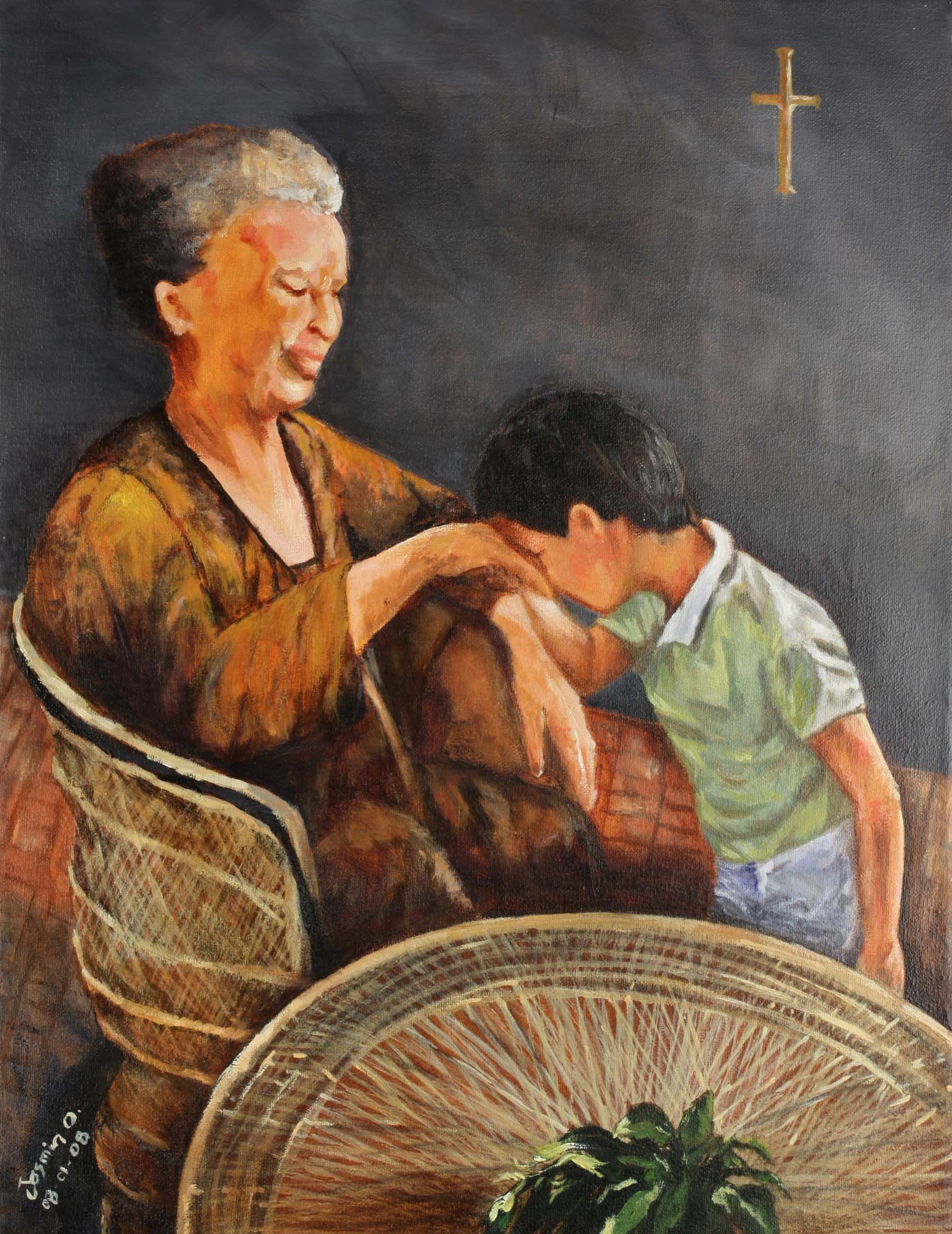
Image of the Filipino “Mano,” a gesture of respect to the elderly. (Artist: Jasmin O.)

My son grew up in an environment where my mother’s caregiving needs were always a backdrop to his childhood and adolescence. However, it also deepened his understanding about the capacity of supportive relationships, humanity, the value of life and time with loved ones.  He grew up knowing medical terms and concepts, understanding it can be an everyday routine for one person to depend entirely on others to survive and that it’s actually okay, not being able to go on family outings with the whole family, and not being able to expect a rigid schedule for things that require flexibility.   My son’s childhood and adolescence involved sacrifice and nothing looked picture perfect because his grandmother was physically disabled, but he learned to go to where a person is and be okay with it.

At a young age, my son learned to deepen his love language, or how to express love to and receive love from a person who is limited by physical disability.  He learned little things, like conversation at home with grandmother, is enough to build a relationship on and enough to continue valuing that bond.  He didn’t require kiddie rides, trips to theme parks, movies at the cinema or lunches at a favorite restaurant to maintain that bond.   My mother would of course have loved to continue doing all those things with him through the rest of his childhood, but she was content with letting him enjoy his outings and hearing stories about them when he got home.  I am so proud of my son for this.  I don’t think he even realizes this is something not everyone learns in youth, but my son demonstrated it through the remainder of his grandmother’s life.

Towards the end before my mother passed away, my son began to share some of the caregiving tasks.  When my father and I needed a break, he would feed her her nutritional formula through the feeding tube in her stomach.  About sixteen years prior, my mother used to feed him infant food.  My mother lived to see things come full circle and witness many milestones in her grandson’s life.  My son matured to watch his grandmother look into his eyes without him having to stand on a footstool to see above the bed rails of her hospital bed.  My son continues to cherish her as someone who is irreplaceable.  Both lives, along with my son’s relationship with his grandfather, forever imprinted by love language that evolves through drastic life changes.

The next time you see the families at the airports, stop and take time to consider the journey they may be on.   The next time you get to know a caregiver with children, consider what their children are going through and the unique perspectives they have to offer.  They may teach you something.

“Children Looking at Taxiing Airplane” Photo Credit – Thaths, used with Creative Commons license ***Special thoughts and prayers for all the families affected by the lives lost on the recent Malaysia airlines flights of 2014. With Kuala Lumpur as my childhood home, I will always remember you, Malaysia and its expat/ foreigner community. – Myra Dumapias***

Ten Ways to Honor Sandwich Generation Expats and TCK’s (2 of 2)

go back to page 1

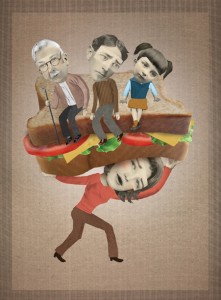
“Generation Sandwich”/Coup de Pouce Magazine, Artist: Isabelle Cardinal Permission obtained from Isabelle Cardinal

 Here are 10 ways we as individuals can honor and support sandwich generation caregivers:

1)  Identify the “sandwich generationers” you cross paths with.  The first step in supporting caregivers is to take the time to consider who they are.  Caregivers, because of the limited time they have in other people’s lives, may not necessarily explain the extent of their caregiving role.  After a certain point in time, the caregiving role may be so ingrained as part of the caregiver’s life that people outside the home don’t even recognize them as caregivers unless the topic naturally came up in conversation.  Bring it up next time in conversations and certain people may come out of the woodwork to speak about what they may have gone through in the past, are about to go through or are currently experiencing.

Some caregivers may think that once they step outside the house, it would be a break for them to not speak much about their experiences unless it is in a private one-on-one setting.  Others may feel that bringing it up is a downer.  This may have to do more with how certain social protocols treat caregiving topics as “personal issues” or “private affairs.”  Society in general also tends to marginalize caregivers and dependent elderly.  The majority of public spaces, such as restaurants for example, are not physically set up to encourage people with disabilities or certain health conditions to be as present as able-bodied persons. (I will further elaborate on this in future writings)

2) Be supportive of the tough choices the “sandwich generationer” makes for themselves and their family.  No matter what anyone may think they know, the truth is every person’s situation is different.   The caregiver and their family members will be the ones who will live with the choices , so it is not in the best interest of the caregiver or their family to promote the choices others may believe to be wiser.  It is helpful to provide feedback, offer another pair of eyes, share ones own applicable experiences and serve as a person to bounce ideas off of, but once the caregiver makes a decision, be supportive of it.  There are reasons why not everyone is consulted in a decision making process.  Chances are there may be aspects of a decision the caregiver believes most cannot fully relate to.  Understand also that there may be a whole side of the situation that you simply don’t know about.  “Sandwich generation” TCK’s or expats especially need the support of other global nomads who can relate to issues of unresolved grief or other issues distinct to a globally mobile childhood or lifestyle.

3) Be personally available to a “sandwich generation” caregiver who may want to share some of their stressful experiences as a way to show they do not have to go through them alone.  Sometimes listening goes a long way.  You don’t have to give advice, especially if you have not been in similar shoes. Just listen and if you feel it would be welcome, encourage a caregiver to open up about how they are doing beyond the “I’m fine, thank you” answers.  Offer genuine attention and time.  Chances are, if you see them for some periods outside the home, the rest of their day or week are probably spent mostly at home.  A nice chat over lunch or a quick one-on-one catch up session to the side of a larger gathering or event helps to reassure a caregiver that someone is there to listen.

If you believe that the caregiver may benefit more from counseling, there are counseling resources available for the expat or TCK caregiver (a page will be added in the near future for such resources upon further research for caregivers with limited income).  However, don’t assume that if you do not offer this help, the caregiver will be fine or that they will go out of their way to reach out to you.

4)  Be careful not to judge or minimize.  This journey is one of the toughest journeys a person can experience in a lifetime for the reasons mentioned above (which touches on just some of challenges).  Each person’s journey is different. While certain aspects of a caregiver’s situation may be similar to another caregiver’s, the entire journey of a person is not the same as another’s.  The context of the timing, family dynamics, circle of support, ability to share tasks with siblings or a spouse, individual need to maintain a career, place in life and many other factors a caregiver is dealing with is never exactly the same as another caregiver’s.  The extent and type of dependency a loved one has on a caregiver can also be extremely different in each situation, as are the financial and other resources available to the family.  Take time to see things from the caregiver’s point of view, and be quicker to find out more before suggesting solutions.

Efforts to “help” others are not effective if they do not address where they are truly at.  See the caregiver as the expert in their own lives (unless for example, by a professional’s judgement, the person’s “actions or potential actions pose a serious, foreseeable, and imminent risk to themselves or others,” a standard in social work practice).  If anyone can take the time to think or say to themselves that other people in the caregiver’s shoes were able to do something differently, they can take the time to speak more to the caregiver and find out why things don’t look the same.   Most importantly, when a caregiver opens up, remember two things – a) believe them the first time and b) treat the trust a caregiver has in confiding in you with utmost respect. 

5)  Understand that the “sandwich generation” role cannot be compartmentalized.  The “sandwich generation” role touches every aspect of a caregiver’s life.  Even though the situation that brought on the dual caregiving role may have come suddenly and has a clear beginning, the end may not be clear or predictable.  The boundary of its impact on the caregiver’s life is not rigid.  A caregiver’s entire life is impacted: Everything from income, to eating patterns, to self-grooming (ie. the distinction between a luxury and a necessity), to sleeping habits, to friendships, to the marriage relationship or dating patterns, to the upkeep of a house, to the competitive edge in the work setting can be affected.  A caregiver needs to take breaks and have distance sometimes to care for themselves so they can be of use to others. However caregiving is not a responsibility one can really set a clear boundary around the way one would with a 9-5 job.  Caregiving requires more flexibilty and even when the caregiver’s role shifts in some major way, their role does not really cease.

6)  Offer help.  This is especially for the single parent caregivers.  Whether one feels qualified or not to help with certain things, offer help where you can.  It may not be obvious what a caregiver needs help with until someone asks.  Offer help in a way the caregiver will understand the offer to be genuine.  Some may be hesitant to ask for fear of not being able to return a favor.  Practical things a “sandwich generation” caregiver can get help with include: getting groceries (of their choice), maintaining a yard, help with fixing house repairs (plumbing or other leaks, electrical wiring, etc.), car repairs or maintenance, errands, etc.  Those with a professional skill, such as carpentry or construction, plumbing, or electrical engineering, or who are lawyers, doctors, social workers, hospice workers, nurses or physical therapists can offer their professional services at a significant discount or for free in recognition of the great hardships of “sandwich generation” caregivers.

I may not be able to convince a reader not already inclined to help others to change their mind, but I will share this: Certain situations don’t have an easy way out and the only reason why certain caregivers are in certain situations is because they chose to brave out the journey and are the only ones around to take responsibility for it.  People who take this level of responsibility deserve help simply because no human being should go through the toughest human experiences alone.  

7)  Expect nothing in return.  Caregivers, especially “sandwich generationers,” may not be in the best position to be as reciprocal as they may have been at a different period in their life or otherwise would be.  Caregivers cherish the support they receive even when a caregiver who may not be able to demonstrate it by spending time with friends or returning a favor.  The caregiver  may not have the luxury of time or money to always reciprocate.  “Sandwich generation” caregivers have to stretch out their resources and time to cover things the average person doesn’t have to budget into their finances or fit into their regular schedule.

For some, this may be hard to hear, but certain favors or gifts may not be reciprocated until the caregiver is in a better position.  This is one factor that can actually lead to a caregiver’s isolation: friends can start to dwindle because caregivers simply aren’t around enough or are able to reciprocate.  TCK or expat caregivers may not even have any friends who are more than acquaintances of casual friends to turn to for help.  Look out for them, even when they aren’t a particularly close friend.

This is simply a personal choice that takes a special heart.  For my readers who help “sandwich generation” caregivers and don’t expect anything in return, know you are serving an army of brave soldiers that face the toughest battles but don’t get enough recognition, special treatment or, especially in the case of expat or TCK caregivers, may not have the support of a “home country” that can provide a safety net for their own future aging.  Thank you!

8)  Assess your work colleague’s credibility with fairness if your colleague is a “sandwich generation” caregiver.  As explained in #5, the caregiving role affects all aspects of a person’s life.  In work relationships, try to translate how the caregiving responsibilities of a person can affect how competitive they can be in comparison to others who more frequently go beyond the extra mile, do things outside their job description or are more flexible.  If a work setting provides the option to work remotely or online, provide ways the caregiver working from home can demonstrate their reliability pertinent to their job role.  Don’t limit such opportunities to colleagues who can be physically present or travel more.  

Perhaps the majority of people at a given work setting have families and responsibilities as well, but remember “sandwich generation” caregivers take on much more than the average head of household.  The credibility or value of a work colleague or employee must include the commitment they demonstrate as a whole person, the bigger picture of their past accomplishments, the quality of their work vs the quantity of times they can be physically present at events, and the skills required not only in practicing their profession, but also managing their time so they can fulfill their duties yet juggle other demanding responsibilities.  

When the skills of a work colleague or employee with a successful track record are applied to the “personal affair” of caregiving, it should not be seen as a compromise to professionalism.  Rather, it should be recognized, honored and respected for the depth of what a person is capable of committing to (often without due recognition).  It is a common myopic perspective about professionalism to marginalize the caregivers and care takers of society or reserve the image of professionalism to people free of nurturing roles or who can place them neatly in a box labelled “private affairs,” which unfortunately affects women more than men(More writings on this topic to follow as well.)

9)  Recognize the single parent “sandwich generation” caregivers.  For every point I make here, remember that there are single parents going through everything I have explained but work with one income and do not have the option of staying at home while a spouse works to make sure the bills are paid.  It is a very difficult journey that requires a level of extreme vigilance to take on this role.  Words are simply not enough to paint the full picture of what single parents in this role go through daily.  Paying the bills on time, making sure any leaks or repairs needed in the house are taken care of, ensuring the car continues to run smoothly, staying on top of doctor appointments and healthy diets for the whole household, and other standard household maintenance tasks, as well as the intricate duties related to caregiving, paying attention to the educational, psychosocial development and other needs of the single parent’s child(ren) AND the overall wellbeing of her/his aging parents must all be accomplished with the budget of a single income earner.  This is not to mention their own needs, including the reality of the necessity to plan for their own aging and retirement.  This is just one side of the picture.  

The single parent in this role must also be able to independently manage the logistics of all of the above in the same amount of time everyone else has, while working to bring in income and doing everything else the average person needs do to for her/his career.  Most employers assign a single type of job role with related duties according to a reasonable work load per employer.  If you picture all the responsibilities of a single parent in a “sandwich generation” caregiving role, it would look like one person operating, managing or supervising all departments of an entire company for a customer base representing three demographics – unpaid for all of the above.  

On top of all of this, the single parent in this role does not have the emotional support a spouse can otherwise provide.   A TCK single parent in this role has an even greater need for emotional support, especially if they start to come to terms with the unresolved grief of their past in different ways through this role.  In an environment that may be void of TCK support or understanding, it can be overwhelming for the TCK single parent who is a “sandwich generation” caregiver.

10) Respect the journey of the family.  Those who are in the position to be personal friends of a caregiver must be understanding when there are occasional family tensions.  Conflict is a normal part of any group setting that forms and develops.  It is understandable that with a family experiencing significant life changes affecting three generations of family members simultaneously, especially under the same roof, certain tensions will come.  In a supportive environment, these tensions will eventually go.  This journey involves different seasons and none of them make a family less worthy of support.  One year, a caregiver may need to quit a job or live with the loved one they are caring for.  Another year, the caregiver may need to prioritize obtaining a certain job or may need to live separately for one reason or another.  

Respecting this journey and the various seasons is to remember that all the family members are just human, have intrinsic human worth and individually deserve to be treated with dignity.  It is truly one of the toughest periods for the elderly persons, the child(ren) in the household and the caregiver(s), and they are all in it out of love for one another.

Source: “The Hindu”

 go back to page 1


Please click here for more information about why this blog was started.

© Myra Dumapias and The Last Boarding Call, 2014-2018. Unauthorized use and/or duplication of this material without express and written permission from this blog’s author is strictly prohibited. Excerpts and links may be used, provided that full and clear credit is given to Myra Dumapias and The Last Boarding Call with appropriate and specific direction to the original content.