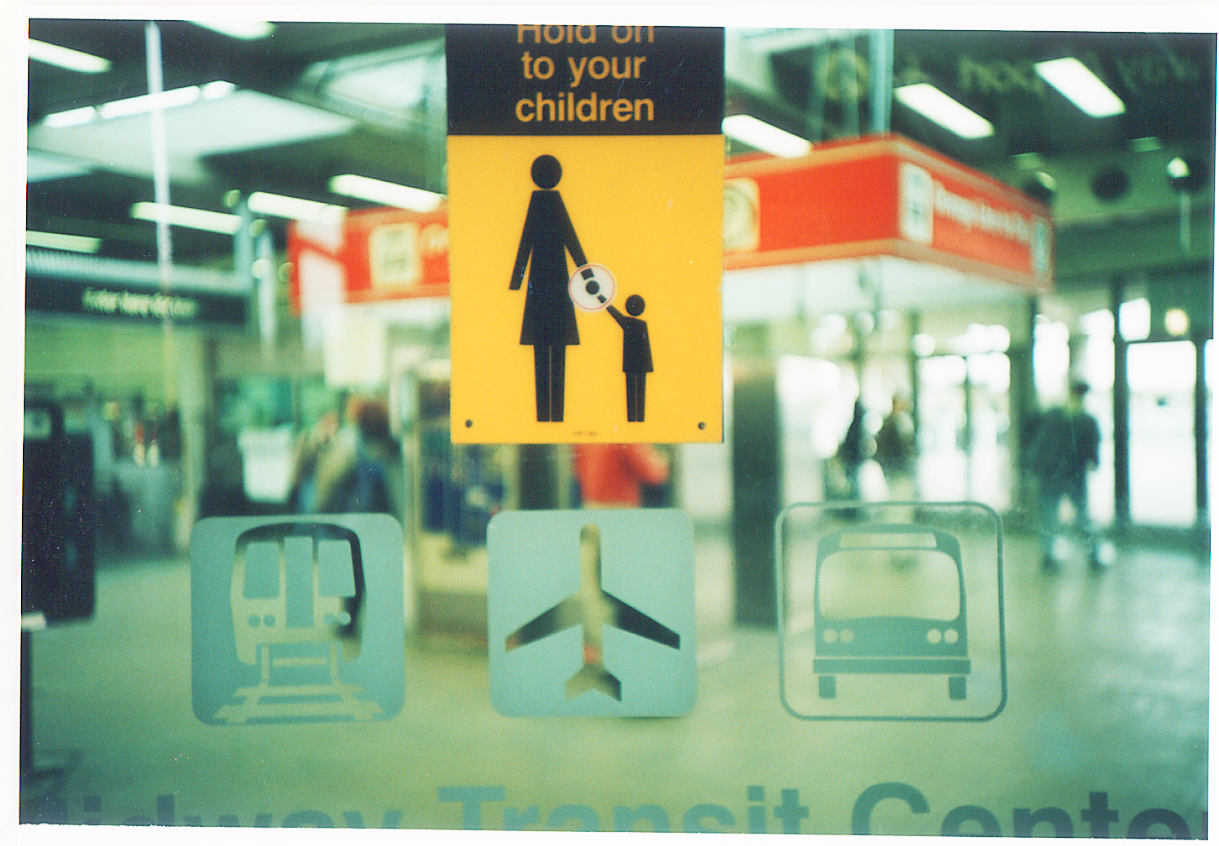
“Hold On To Your Children” Photo Credit – Spiesteleviv Used with Creative Commons license
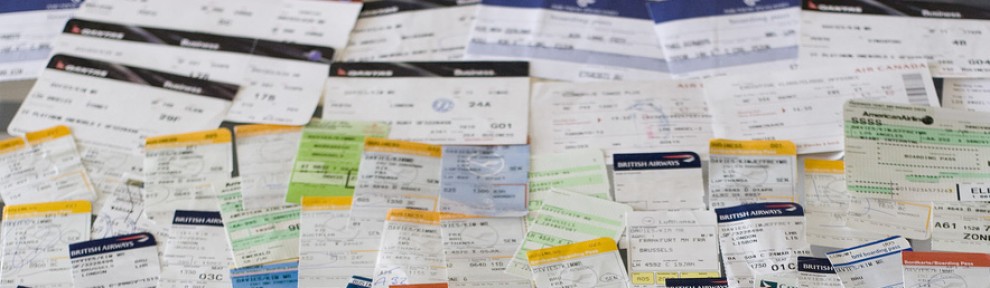
We see families at the airports, at times perhaps with more than two generations represented, briskly walking through the terminals in long single file or as a wide marching band at a parade with various carry-on luggage as musical instruments.
While middle aged adults that pass through the airport corridors seem to begin to resemble one another in attire, the younger passengers tend to show more individuality:
…the teen girl with a partly shaved head with purple tips wearing a Ramones t-shirt, the tween boy with one eye covered by his long hair dressed in black or grey clothes, the cosmopolitan little lady wearing her kid sized tweed travel jacket with suede elbow patches, the toddler with a bowl haircut in the stroller calmly snacking on soft cookies while the mom is dashing for the connecting flight, and the baby in the infant carrier kicking the air and giggling at strangers behind his father who enlarge their eyes as part of their big open-mouthed, head nodding smile.
If we could see a floating bubble attached to each family member narrating a summary of each person’s story or reason for the trip, we’d probably be amazed by the depth of what we don’t know about strangers. Out of these stories are trips adults make to tend to a family member experiencing a sudden health crisis, and their children, whether they travel with their parent(s), stay behind or end up following after, are affected.
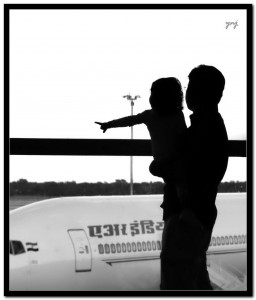
“Granny… I Am Coming!” Photo Credits: Yogendra Joshi, used with Creative Commons license
My son and I lived one of these stories. I received the call that my mother had a stroke the night after my son attended his first day at kindergarten. We were in Los Angeles, California. My parents were in Manama, Bahrain. I was preparing to start my second year for my Masters in Social Welfare at UCLA. I had just met my supervisors for my second year internship placement. I was about to serve as one of two co-presidents who tied in elections for the Social Welfare Asian Caucus that upcoming year. That would have been my final year for a graduate program that accepted only 20% of its applicants. My son had to take leave of absence after just one day in kindergarten and I had to file for leave of absence before my second year orientation even started.
Since that phone call, our lives as a collective family as well as each of our lives individually, were never to be the same or “normal” again.
I had no idea that the photos I took of my son’s first day of kindergarten were not going to be the first in a series of photos representing the traditional path of education most children living in one country take. I had no idea it would take me several years to finish my masters degree for a program that usually lasts for two years.
When my son and I left to go to Manama, I only knew a portion of what I was about to find out as soon as I landed. It turned out that what I thought was a mild stroke for a 57-year-old woman was actually a severe stroke, involving the cerebellum and a coma. My mother’s doctors did not hold back from preparing my dad for funeral arrangements.
It was a long journey itself to watch my mother in her coma. People did not dare to raise our hopes about her situation and I could see in some of the eyes of my parents’ friends at the hospital that they themselves were scared to hope. Most of my mother’s siblings were there visiting, but it is a world of a difference when a health crisis like this happens continents away from the larger family. My father described the days before my mother’s siblings, my son and I arrived in Bahrain as the loneliest and longest days in his life.
My family went through a rough, dark, faith-testing journey while visiting my mother daily in her comatose state. However, after three weeks, she came out of that coma that was supposed to take her mental alertness, memory, speech, and overall capacity to interact with us again if she even survived. Never in a million years did I have a clue I could ever find strength though an experience like that, but I found it through prayer.
When she woke up, our small family, consisting of my father, my son and myself, were about to live the rest of our lives with a family member who would be disabled without the ability to walk, sit on her own, go to the bathroom by herself and swallow food and liquid completely. Yet my mother was so filled with life and a desire to be around us that she mustered up enough strength, faith and passion that she survived that stroke for almost 12 years. It may sound like torture to some of my readers, but it is a gift when the survivor is your loved one. It is a gift when you see your loved one’s eagerness to keep waking up to see another morning with and say another “good night” to her husband, only daughter and only grandson, and enjoy everything that can happen in between.
This drastic life change came much earlier than I had anticipated. I had imagined that if I were to experience a sudden onset of disabling illness of one of my parents, that my son would perhaps be in high school or college. My son was four years old, about to turn five.
 Up to that point, what my son knew about his grandmother after the time she stayed with us when he was born and during the few months after, were our visits to the Middle East, my parents’ visits with us in the US, letters with photos, and gift packages filled with books, snacks, clothes and toys. After this point, the one he used to know as his active grandmother excited and delighted to meet him at airports and who threw big celebrations for his birthdays became someone who spent the majority of her days lying down in a hospital bed if not in a wheelchair.
One of the areas a middle aged or elderly person’s health crisis can affect grandchildren is their education. In our situation, my son’s education involved various twists and turns because of the series of relocations necessary to accommodate for my mother’s caregiving needs as well as the transitory nature of my father’s career. The temporary leaves of absence we had in our perspective schools became permanent withdrawals.
By the time my son turned five, when it became clear that we were going to live in Bahrain for some time, he started attending the Philippine School in Manama. He was nicknamed “Little Ambassador” after my father, who helped secure a much larger property for the campus together with the Prime Minister of Bahrain. By the time my son turned six in the Midwest, where my mother temporarily stayed with a sister while my father’s assignment was in transition, I was homeschooling my son. The timing of my parents’ relocation and the availability of caregiving resources did not align with school semesters. After living in Bahrain, my son and I lived back and forth between the Midwest and California until my father’s next assignment to Mexico.
The rest of my son’s education involved a quilt of educational settings that involved difficult decisions, paying for private school, attending a school on a scholarship that taught three foreign languages, trial and error, more homeschooling, and adjusting to the transitions between the US public school system divisions of elementary, junior high and high school. Looking back as a parent, I may have been able to make different decisions and stick to one, but each school transfer decision was made for a good reason. A few of the experiences could only be discovered with trial and error and some decisions had to be made to fit our family’s unique needs and circumstances.
Not only was my son’s education affected, but my mother’s stroke also affected his own personal growth. The children of caregiving parents can also be affected when their parents’ caregiving role plays a large part of their daily environment. This may apply to a daily environment of one parent’s absence.
When my father retired, I started supporting my parents due to the various needs that come with physical disability and post-stroke health management. This impacted my son’s life dramatically. My son left a school that he grew to love so that we all could move to a city where it was economically feasible for me to support everyone. We all moved in together so it would be practical for me to help with my mother’s caregiving as a single parent without someone to tag team with and to make sure my father, as my mom’s main caregiver, also stays healthy.
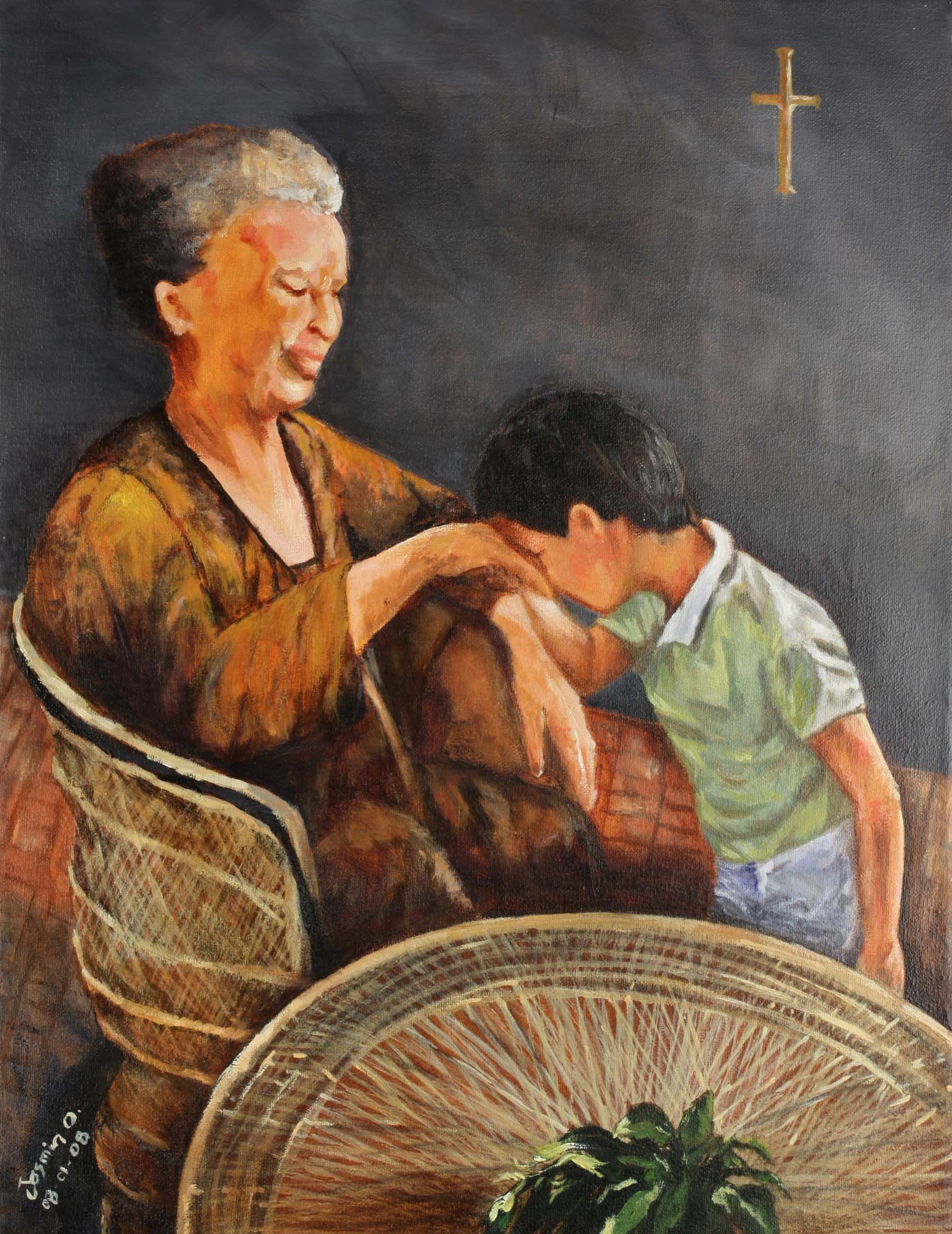
Image of the Filipino “Mano,” a gesture of respect to the elderly. (Artist: Jasmin O.)
My son grew up in an environment where my mother’s caregiving needs were always a backdrop to his childhood and adolescence. However, it also deepened his understanding about the capacity of supportive relationships, humanity, the value of life and time with loved ones. He grew up knowing medical terms and concepts, understanding it can be an everyday routine for one person to depend entirely on others to survive and that it’s actually okay, not being able to go on family outings with the whole family, and not being able to expect a rigid schedule for things that require flexibility. My son’s childhood and adolescence involved sacrifice and nothing looked picture perfect because his grandmother was physically disabled, but he learned to go to where a person is and be okay with it.
At a young age, my son learned to deepen his love language, or how to express love to and receive love from a person who is limited by physical disability. He learned little things, like conversation at home with grandmother, is enough to build a relationship on and enough to continue valuing that bond. He didn’t require kiddie rides, trips to theme parks, movies at the cinema or lunches at a favorite restaurant to maintain that bond. My mother would of course have loved to continue doing all those things with him through the rest of his childhood, but she was content with letting him enjoy his outings and hearing stories about them when he got home. I am so proud of my son for this. I don’t think he even realizes this is something not everyone learns in youth, but my son demonstrated it through the remainder of his grandmother’s life.
Towards the end before my mother passed away, my son began to share some of the caregiving tasks. When my father and I needed a break, he would feed her her nutritional formula through the feeding tube in her stomach. About sixteen years prior, my mother used to feed him infant food. My mother lived to see things come full circle and witness many milestones in her grandson’s life. My son matured to watch his grandmother look into his eyes without him having to stand on a footstool to see above the bed rails of her hospital bed. My son continues to cherish her as someone who is irreplaceable. Both lives, along with my son’s relationship with his grandfather, forever imprinted by love language that evolves through drastic life changes.
The next time you see the families at the airports, stop and take time to consider the journey they may be on. The next time you get to know a caregiver with children, consider what their children are going through and the unique perspectives they have to offer. They may teach you something.
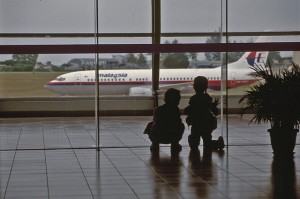
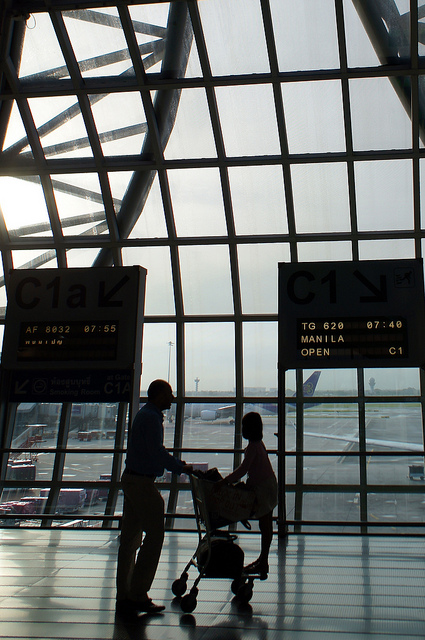
“Children Looking at Taxiing Airplane” Photo Credit – Thaths, used with Creative Commons license ***Special thoughts and prayers for all the families affected by the lives lost on the recent Malaysia airlines flights of 2014. With Kuala Lumpur as my childhood home, I will always remember you, Malaysia and its expat/ foreigner community. – Myra Dumapias***